%20(16).svg)
.png)
.svg)
.svg)

Crypto has spent years treating privacy and composability like an either/or decision.
Want your token to plug into existing DeFi, wallets and exchanges? Keep it public.
Want confidentiality? Move into a separate shielded asset, accept extra UX, fragmented liquidity and a different integration path.
That tradeoff made sense when privacy was something you bolted onto a token after the fact.
It makes much less sense as a default for financial assets.
We believe the next evolution of token standards is pretty simple:
one asset, two modes.
Public when you need composability.
Confidential when you need privacy.
And the user decides which one makes sense in the moment.
That is the idea behind Fhenix’s Dual ERC Token Standard based on Fully Homomorphic Encryption (FHE).
Public money was version one
ERC-20 was one of crypto’s most important standards because it gave the ecosystem a common language for tokens.
That standardization unlocked everything around it: exchanges, wallets, lending markets, DEXs, custody, analytics.
But ERC-20 came with one assumption we’ve mostly stopped questioning:
balances are public by default.
For early crypto, that was acceptable.
For an internet-native financial system serving individuals, businesses and institutions, it becomes increasingly hard to justify.
Your bank balance isn’t public.
Your payroll isn’t public.
Your company treasury isn’t public.
Your trading positions aren’t public.
Yet move those same assets onchain and suddenly publishing financial information becomes part of the product.
That shouldn’t be the end state.
Privacy tokens solved one problem and created another
The obvious answer has traditionally been to create a separate private version of an asset.
You take an ERC-20, deposit it into another contract and receive a shielded token in return.
Technically, you now have privacy.
Product-wise, you now have two assets (which entails two addresses, two balances)…
Another approval - another integration.
Another thing for the user to understand.
And, most importantly, liquidity and composability start fragmenting.
Fhenix’s Dual ERC model takes a different approach: the public and confidential balances exist behind one canonical ERC-20 address. Shielding and unshielding happen inside the token rather than through an external wrapper.
That difference sounds technical.
It’s actually a UX decision.
The user never has to think:
“Which version of this token do I own?”
They own one asset.
One token. Two states.
A Dual ERC token maintains two balance states for the same holder.
The unshielded balance behaves like a standard ERC-20: it is publicly visible and compatible with existing DeFi protocols, wallets, CEXs and other infrastructure.
The shielded balance keeps amounts encrypted using Fully Homomorphic Encryption (FHE), computed by Fhenix's CoFHE coprocessor, so the contract can update balances without ever decrypting them. Confidential-transfer amounts and balances are private, although the current design still leaves sender, receiver and transaction timing visible onchain.
That distinction matters because dual-mode is not pretending the privacy/composability tradeoff has magically disappeared.
It makes that tradeoff explicit and user-controlled.
Today, the public side gets full existing DeFi composability.
The confidential side gets encrypted balances and transfers, while its compatibility with existing DeFi and wallets is more limited.
And we actually think that honesty is one of the strongest things about the model.
No cryptography can make every existing public DeFi protocol suddenly operate on encrypted state.
So instead of pretending there is no tradeoff, give users a choice.
The same dollar can behave differently at 9am and 5pm
This is where dual-mode gets really interesting.
Imagine you hold $10,000 of a stablecoin.
In the morning, you want $3,000 publicly available as collateral in Aave.
You keep that portion unshielded.
Later, you want to send $2,000 to someone without broadcasting the amount.
You shield that portion and make the confidential transfer.
Same token.
Same canonical asset.
Different context.
The Dual ERC design allows a holder to maintain both public and confidential balances simultaneously. Shielding moves funds into encrypted state; unshielding makes them public and DeFi-accessible again.
This is much closer to how people actually use money.
Privacy isn't a permanent identity.
It is contextual.
Sometimes you want something public.
Sometimes you absolutely do not.
See our Dual Mode Stablecoin demo — one stablecoin that switches between visible and hidden transaction modes, live on testnet.
And that is where dual-mode becomes inevitable
Because the alternative is asking every user to make the same permanent choice:
privacy or utility.
That’s bad product design.
People don’t want “privacy coins” and “public coins” for every financial asset they use.
They want their assets to adapt to what they are doing.
The same logic already exists everywhere else.
You don’t have a “public Google Drive” and a completely separate “private Google Drive.”
You choose who can see a file.
You don’t need a second bank account just because one payment requires more confidentiality.
And eventually we think it will feel equally strange that crypto required an entirely different token just because you wanted to stop broadcasting a balance.
Stablecoins make the problem obvious
Stablecoins are probably where this gets hardest to ignore.
They are increasingly being positioned as internet-native money.
But internet-native money with permanently public balances is a strange end state.
Imagine paying salaries in stablecoins at scale.
Or settling B2B invoices.
Or managing a corporate treasury.
Or allowing AI agents to transact autonomously.
Now imagine every balance and every amount being permanently available for anyone to analyze.
At some point, confidentiality stops being a crypto-philosophy conversation and becomes basic financial infrastructure.
And that’s what stablecoins can provide when built natively on the Dual ERC standard: operate publicly in standard DeFi contexts or move into shielded mode for confidential stablecoin transfers.
That’s the model Fhenix expects to see much more of.
As Guy Itzhaki, CEO of Fhenix, puts it: "The future of payments is private, programmable, and permissionless."
No more new private ecosystems users have to migrate into. Existing financial assets gaining a confidential mode.
The next token standard shouldn't make privacy the destination
For years, the privacy UX in crypto has essentially been:
leave the normal financial system → enter the private one → come back when you need liquidity.
We don't think that's how confidentiality wins.
It wins when the user barely needs to think about it.
You hold one token.
You need DeFi? Use the public state.
You need confidentiality? Shield it.
You need public liquidity again? Unshield it.
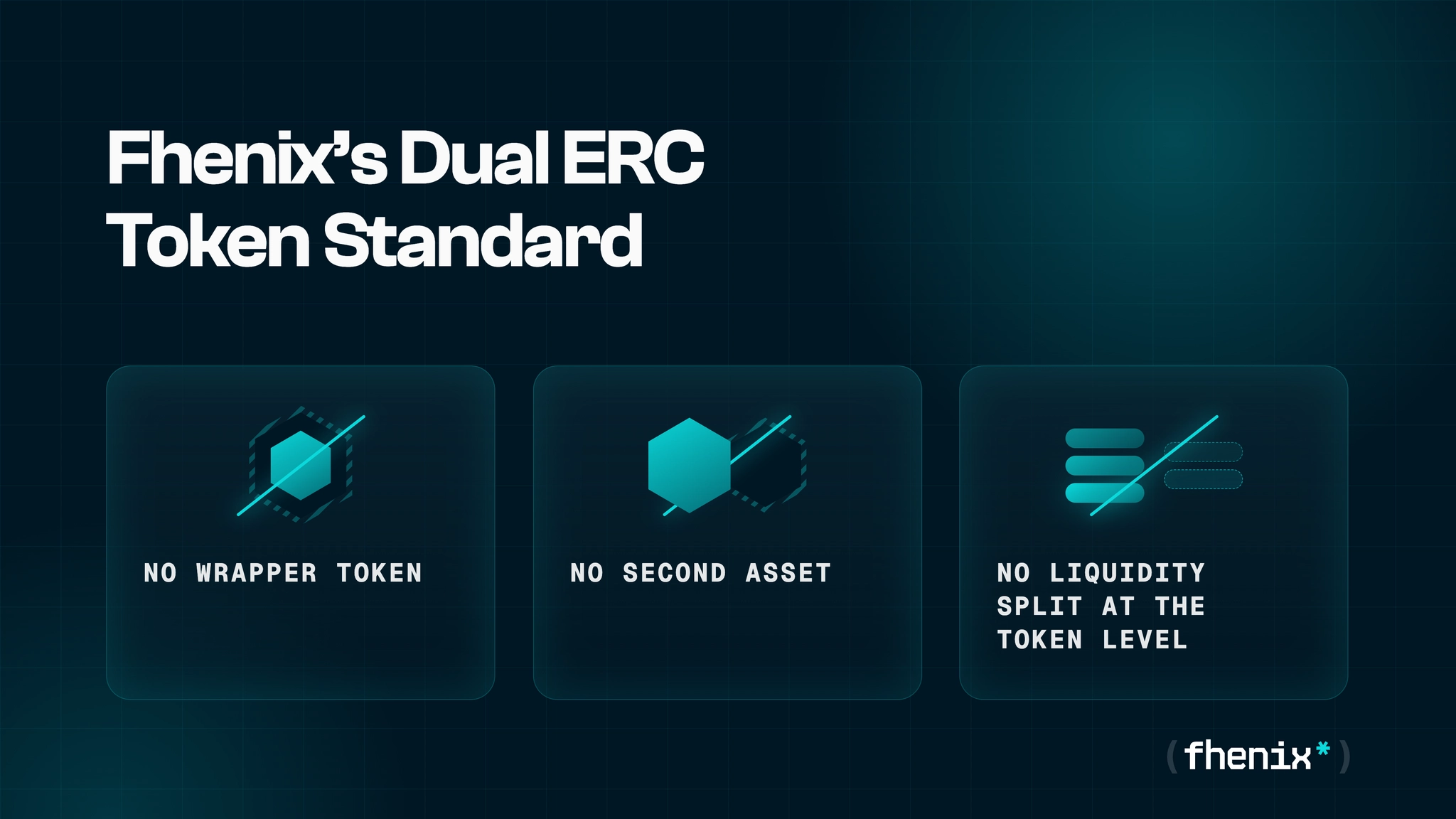
Diagram of a dual-mode ERC-20 token switching between a public mode and a shielded, encrypted mode
And over time, as private DeFi primitives become more capable, the gap between those two states should get smaller too.
Public money was version one. Dual-mode is version two.
The first era of blockchain proved that financial activity could be publicly verifiable.
The next one needs to prove something harder:
that verification doesn't require exposing your entire financial life.
At Fhenix, we don’t think every transaction needs to be private.
We don't think every transaction should be public either.
That binary thinking is exactly what dual-mode tokens get rid of.
One asset - two modes:
Privacy when it matters, composability when you need it.
Public money was version one.
Dual-mode is version two.
See the full set of live FHE demos
Learn more and see a live demo from Fhenix’s livestream on X:
https://x.com/i/broadcasts/1NxarrboqYlKj?s=20
Frequently Asked Questions
- What is a dual-mode token? A dual-mode token is a single token that maintains both a public and a confidential balance for the same holder at the same canonical address. The public balance behaves like a standard ERC-20 and works with existing DeFi. The confidential balance keeps amounts encrypted. Holders shield and unshield between the two states as needed.
- How is a dual-mode token different from a wrapped privacy token? A wrapped privacy token creates a second asset at a second address, which fragments liquidity and forces users to manage two balances and two integrations. A dual-mode token keeps one canonical asset and moves value between public and confidential states inside the token itself.
- Does the confidential balance hide everything? No. Confidential transfers hide amounts and balances, but sender, receiver, and transaction timing remain visible onchain. Dual-mode makes that tradeoff explicit and user-controlled rather than hiding it.
- Can I use a confidential balance in DeFi? The public side keeps full composability with existing DeFi protocols, wallets, and exchanges. The confidential side supports encrypted balances and transfers, with more limited compatibility today, which is why holders can move value between states.
- Why do stablecoins make dual-mode necessary? Stablecoins are used for payroll, treasury operations, and settlement, where broadcasting amounts is unacceptable, yet the same asset must stay composable with public DeFi. A single asset that can be public or confidential per transaction fits how money is actually used.
- What technology makes confidential balances possible? Fully Homomorphic Encryption (FHE) lets a smart contract compute over encrypted values without decrypting them. Fhenix's CoFHE coprocessor performs that computation and returns encrypted results to any EVM chain.

.svg)
.svg)
%20(15).svg)