%20(16).svg)
.webp)
.png)
.svg)
.svg)

Current DeFi infrastructure leaks critical information and wastes economic potential. This creates a fundamentally unfair and inefficient ecosystem for users.
- For Swaps, every on-chain trade exposes its size, direction, and timing, allowing MEV bots to front-run and sandwich transactions. The result is privacy-broken, alpha-leaking trading where users lose value to extractive bots.
- For Yield Management, advanced strategies are run by closed, specialized teams. Everyday LPs and DAOs are left with basic vaults whose returns are capped by the operating team's knowledge, not the true potential of the market.
Alpha Engine solves both. It introduces a new paradigm built on privacy and open competition. It makes swaps private by default- encrypted at the source, batched, and settled only as a public net position to eliminate MEV. Simultaneously, it makes yield management open and trustless through Universal Encrypted Intents (UEI), enabling anyone to securely contribute strategies.
Together, these mechanisms transform Uniswap liquidity into a global, privacy-preserving marketplace where the best strategies, not privileged access, set the yield curve.
How AlphaEngine Works: A Two-Pillar Solution
AlphaEngine's architecture is a powerful synergy of three key technologies: the composability of Uniswap v4 Hooks, the privacy of Fhenix's FHE coprocessor, and the decentralized trust of an EigenLayer AVS. This creates a system that executes complex, confidential logic off-chain while settling securely on-chain.
Pillar 1: Confidential Swaps to Neutralize MEV
This pillar redesigns the trading process to shield it from public view, starving MEV bots of the information they need to profit.
The Confidential Trading Flow:
- Encrypted Intent: A user encrypts their swap details (e.g., "sell 10 ETH for USDC") on the client side using
cofhe.js. This intent is private before it ever touches the network. - Encrypted Escrow: The user submits this encrypted intent to the AlphaEngine hook on Uniswap v4. The hook then escrows the user's funds using the FHERC20 encrypted token standard.
- Off-Chain Matching: A decentralized network of operators (an Actively Validated Service, or AVS) privately decrypts and matches a batch of these intents in a First-In-First-Out (FIFO) order. This process is designed to occur within a Trusted Execution Environment (TEE) to ensure no party, including the operators, can ever view the decrypted intents.
- Atomic Net Settlement: To maintain end-to-end privacy, the AVS operators submit the final net transaction via a private mempool like Flashbots or SUAVE. This prevents information leakage before settlement. The hook verifies the operators' cryptographic signatures to ensure the batch was processed correctly before executing the single, atomic swap on the public Uniswap v4 pool.
The Impact: If a batch is perfectly balanced, no public swap occurs at all. This dramatically reduces slippage and completely eliminates the information leakage that enables MEV.
Pillar 2: Universal Encrypted Intents (UEI) for Open Yield Markets
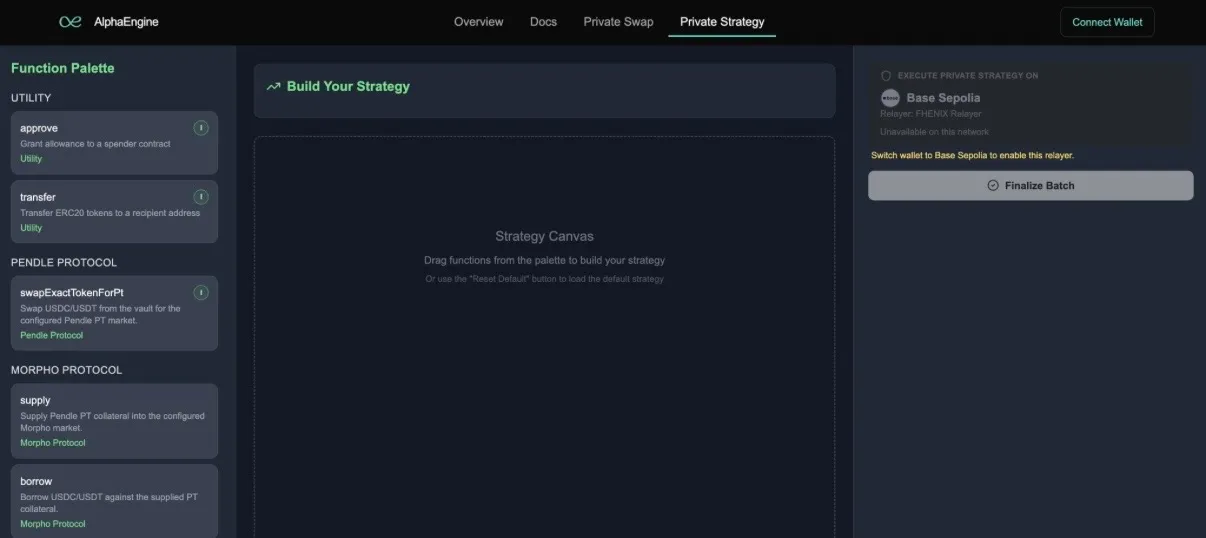
In Uniswap-style AMMs, only a small fraction of total liquidity is actively used for swaps, while the majority remains idle. Through UEI, advanced traders can decide where the system's capital can be allocated to external protocols, such as Aave, Morpho, or Pendle, all without revealing position details or strategy parameters.
The Open Alpha Flow:
- Encrypted Strategy Submission: Anyone can formulate a yield strategy and submit it as an encrypted intent. Critical parameters like asset allocation and risk thresholds remain private.
- Private Execution: The AVS operator network runs rigorous risk simulations and backtesting validation on the proposed strategy. Once validated, the AVS executes and monitors the strategy off-chain, keeping the proprietary logic confidential.
- Trustless Verification & Payout: The AVS committee generates a signed attestation of the strategy's realized APY, which is then verified by the on-chain
IntentManagercontract. This contract enforces risk limits and distributes profits to the LPs and the strategist accordingly.
The Impact: This creates a true meritocracy where strategies are judged solely on their performance, potentially boosting yields from a typical 4-5% to over 12-15%. It effectively turns passive liquidity pools into active, market-driven hedge funds. 📈
Architecture & Security
- Encrypted: User swap amounts, internal fund transfers, specific UEI strategy parameters, and sealed user balances.
- Public: Pool IDs, token pairs, the net size of a batched swap, and settlement events.
Core Components:
- Uniswap v4 Hooks: AlphaEngine is built as a hook, a new feature in Uniswap v4 that allows developers to insert custom logic at key points in a liquidity pool's lifecycle.
- Fhenix (CoFHE): This is the specialized co-processor that provides the FHE capabilities, including the FHERC20 standard and granular access controls. It also handles user-side privacy, allowing users to read their own encrypted balances by creating a temporary viewing permit and unsealing the data locally.
- EigenLayer AVS: Powers the operator committee for decryption, simulation, and batch validation, ensuring slashable correctness. Using Fhenix's permit-based access control, operators are granted temporary, scoped permissions to decrypt specific data within a secure environment.
Security Mechanisms:
- MEV Resistance: Orders are encrypted at the source, and only the net delta of a batch is ever made public.
- Strategy Privacy: UEI parameters remain encrypted throughout execution.
- Operator Integrity: Threshold-based decryption prevents any single operator from acting alone, while a random committee of operators is selected for each batch to prevent collusion or capture. The AVS then provides economic security through slashing.
- Unlinkability: Internal transfers are re-encrypted during settlement, cryptographically severing the link between a user's initial deposit and their final received assets.
FHERC20: Confidential Value Transfer
Instead of implementing numerous low-level FHE operations, AlphaEngine leverages the high-level FHERC20 interface. Functions like transferFromEncrypted encapsulate all the necessary FHE operations under the hood. This allows AlphaEngine to manage deposits, internal settlements, and payouts entirely on encrypted balances, preventing on-chain observers from tracking the flow of value between individual users. It is the cornerstone of the system's privacy guarantees.
Conclusion: A Blueprint for the Future of DeFi
AlphaEngine exemplifies a new design pattern for DeFi: encrypt at the edge, compute confidentially off-chain, and settle only the net result on-chain. By solving the core problems of information leakage and capital inefficiency, it delivers significant outcomes:
- Zero-Leakage Execution: Traders’ sides, sizes, and timing are never exposed.
- Composable Confidentiality: The hook architecture preserves full Uniswap compatibility.
- Capital Efficiency: Off-chain netting can reduce slippage significantly, ensuring better prices for users.
- Fair Access to Alpha: Encrypted strategies turn institutional-grade tooling into open, permissionless infrastructure.
Bottom Line: AlphaEngine is fixing DeFi's Leaky Foundation and provides Private MEV-Proof Trading & Open Yield for DeFi.
This marks a pivotal moment where on-chain privacy moves from a theoretical concept to a powerful, implemented reality, unlocking the true potential of decentralized finance.
In our E1 of Case Files*, we discussed how confidentiality and anonymity intersect. If you're curious how exactly @FlutonIO tackles it using CoFHE, this article will be a good read.

.svg)
.svg)
%20(15).svg)